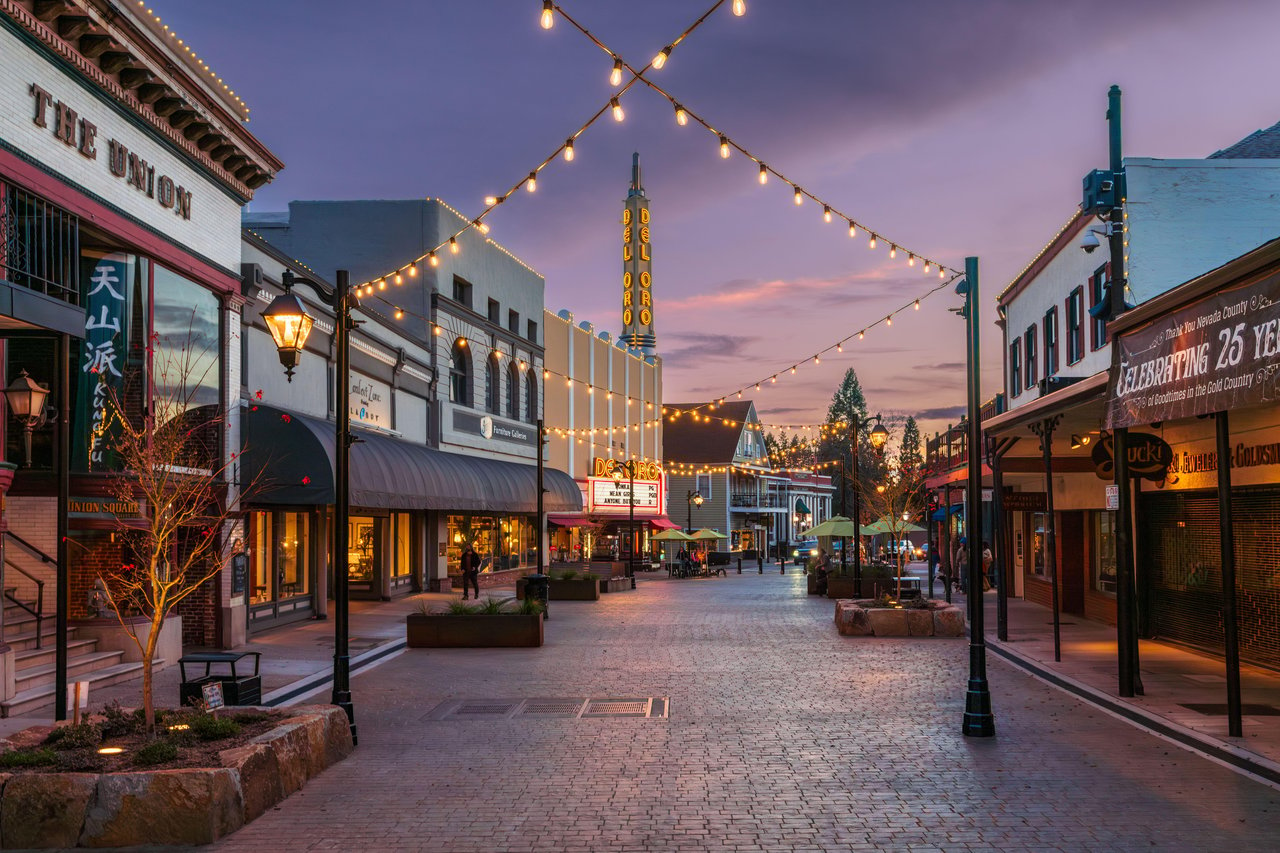
Grass Valley
When I first thought about moving up here, I was convinced I wanted to live in Nevada City.
I was coming from San Francisco, and Nevada City felt like the closest match. Downtown had a little more charm, a little more personality, it was a little more… me.
My best friend said something that completely changed how I approached it:
“Don’t pick the town. Pick the house. Just make sure you’re close to both. Towns change. One will feel better than the other at different times.”
She was right.
I found my perfect home in Grass Valley. Seven minutes to Mill Street. Eleven to Nevada City’s Broad Street. Close enough that I never have to choose.
What it does offer: livability.
Grass Valley is where life actually happens.
Downtown centers around Mill Street and Main Street, and it works. Easy to park. Easy to walk. A mix of polished shops and everyday places you actually use. This is where you run errands, grab what you need, and still have somewhere nice to wander into along the way.
It’s also where you’ll find some of the best little pleasures. The kind of candy and ice cream shop that somehow still gets it right. Not overdone. Just good.
I go to Nevada City for dinner sometimes. Maybe a movie. But most of life? It happens here.
The landscape is part of what makes Grass Valley feel so grounded.
To the south and west, it opens into rolling acreage dotted with oak trees. Classic foothill horse country. To the east of Highway 49, everything shifts. Dense conifer forest. Tall pines. Cooler, shaded, and quiet in a completely different way.
You get options here. And they’re all beautiful.
And then there’s the history.
Grass Valley exists because of gold. During the California Gold Rush, this was one of the richest mining regions in the state. Not just surface gold, but deep underground hard-rock mining. The Empire Mine became one of the oldest, largest, and richest gold mines in California, producing millions in gold over its lifetime. You can still visit Empire Mine State Historic Park today and walk through that history.
There’s also a quieter kind of cultural history here. Musicians, artists, and people who didn’t quite fit anywhere else have been landing in this region for decades. Jonathan Richman has long had ties to the area, which makes sense. It has a lot in common with the New England towns he grew up in.
That creative thread is still very much alive. The Center for the Arts anchors a lot of it, bringing in live music, performances, and community events that give the town a cultural pulse you might not expect at this size. And then there are the smaller, local expressions of that same spirit, like Gold Vibe Kombuchary, where wellness, community, and a slightly offbeat creative energy all come together.
Mornings might look like grabbing coffee from Brewbakers and heading back home, looking out over land that is actually yours. Afternoons are errands that don’t feel like a chore because everything is close, and you’ve got a forest or open sky in front of you.
And then there’s the Yuba. Yuba River
It’s just a short drive away, but it’s part of life here. Summer days stretch out along the river. Cold, clear water, sun on granite, time that slows down whether you planned for it or not. Around here, people tend to measure a good year by how often they made it to the Yuba.
Evenings? Stay in by the fireplace. Or head out. Dinner at Lola or Dakar in Nevada City will make a San Franciscan feel like they’re home. Cirino’s or The Owl in Grass Valley are easy, delicious, and right there when you want them. You’ve got options.
There’s energy here, but it’s steady.
Transportation isn’t the story. This is a driving community. But you’re never far from what you need, and that’s what matters. Can you live car-free here? Absolutely. You’ll want to be downtown, where you can walk to everything.
If you’re looking for nightlife on every corner, this isn’t it. But if you want acreage, ease, and a place where your day-to-day life actually feels manageable… Grass Valley delivers.
The median age in Grass Valley is in the mid-40s, with a mix of long-time locals, retirees, and people relocating from larger cities. A large portion of the community has come from the Bay Area. Translation: this is a town of transplants who came for a different quality of life and decided to stay.
HOME: Grass Valley offers a wide range of properties, from in-town homes to larger parcels of land. Prices typically start around $450,000 for smaller homes or condos and climb into the $800,000 to $1,500,000+ range for updated homes on acreage. Larger estates and premium properties can reach well above that. This is where you can still get space, land, and a sense of ownership that’s increasingly hard to find, especially coming from the Bay Area.
48,384 people live in Grass Valley, where the median age is 51.5 and the average individual income is $42,708. Data provided by the U.S. Census Bureau.
Total Population
Median Age
Population Density Population Density This is the number of people per square mile in a neighborhood.
Average individual Income
Grass Valley has 20,174 households, with an average household size of 2.375. Data provided by the U.S. Census Bureau. Here’s what the people living in Grass Valley do for work — and how long it takes them to get there. Data provided by the U.S. Census Bureau. 48,384 people call Grass Valley home. The population density is 324 and the largest age group is Data provided by the U.S. Census Bureau.
Total Population
Population Density Population Density This is the number of people per square mile in a neighborhood.
Median Age
Men vs Women
Population by Age Group
0-9 Years
10-17 Years
18-24 Years
25-64 Years
65-74 Years
75+ Years
Education Level
Total Households
Average Household Size
Average individual Income
Households with Children
With Children:
Without Children:
Marital Status
Blue vs White Collar Workers
Blue Collar:
White Collar: